
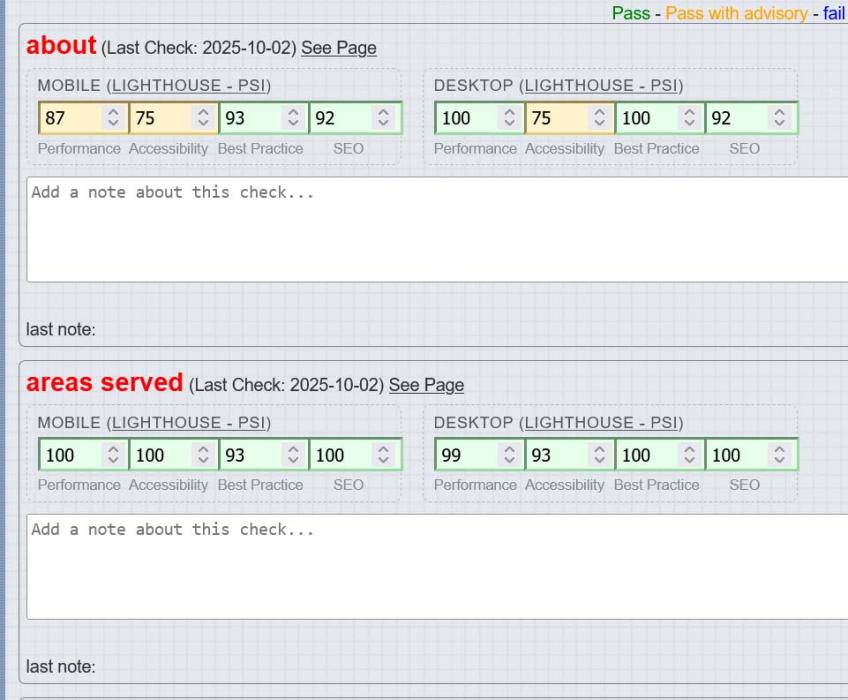
TWS has integrated Google Lighthouse directly into the Quality section of COUNTA.
Every key page now shows Lighthouse scores and concrete fixes right where we plan and track quality assurance. No more random ad-hoc PageSpeed tests—COUNTA is the single place to see, decide, act, and show progress.
The Quality section of COUNTA is where customers can review their individual pages and track decisions and progress. It makes sense to include industry-standard Lighthouse test results here, facilitating a broader scope for quality-improvement opportunities—particularly for TWS during site reviews.
Why this matters
-
One source of truth: Performance, Accessibility, Best Practices, and SEO are visible per page alongside owners, due dates, and status.
-
Actionable, not abstract: Each finding links to a plain-English recommendation (e.g., “Add
langto”, “Give icon links anaria-label”), so fixes can be picked up immediately. -
Page-by-page communication: When a customer asks “How’s the Books page doing?”, you can open COUNTA, show the page card, and walk through scores, issues, and the plan.
-
Fits PDCA: The data slots straight into our ISO 9001 cycle—Plan improvements, Do the change, Check the score shift, Act by standardising the fix across templates.
-
Easier to demonstrate value: Simply put, by displaying this information in this way, we can demonstrate, at a glance, the value of a page with regard to these industry-standard metrics.
How the integration works
-
Per-page cards in COUNTA now display the four Lighthouse scores with colour badges (green/amber/red), current actions, and owners.
-
Click a finding to see the recommended fix, a snippet/example, and our internal checklist (e.g., contrast ratios, Core Web Vitals hints, meta tags).
-
Definitive reference: COUNTA keeps a definitive reference that is superior both to having nothing at all and to other methods such as off-platform spreadsheets.
-
Customer-ready views: We can share page-level summaries during reviews—clear, non-technical language with any planned remedies and ETA.
The four Lighthouse criteria (and why your customers feel them)
1) Performance
What it is: Page speed and responsiveness (e.g., how quickly content appears and becomes usable).
Why it matters: Faster pages rank better, get more clicks, and convert users who might otherwise bounce. Customers experience this as “your site feels quick and professional.”
Typical fixes we action:
-
Optimise images (modern formats, dimension hints,
loading=lazy). -
Reduce JavaScript (defer non-critical, remove unused libraries).
-
Cache and compress (HTTP caching, gzip/brotli).
-
Improve server response (CDN, efficient queries).
Business impact: Faster pages → higher engagement and more sales/leads.
2) Accessibility
What it is: How usable your site is for people with disabilities (and, frankly, everyone).
Why it matters: Accessible pages reach more people, reduce friction, and build trust. Many a11y improvements also help SEO and mobile users.
Typical fixes we action:
-
Provide discernible names for links and buttons (text,
aria-label, imagealt). -
Ensure colour contrast passes WCAG guidelines.
-
Use proper semantics (headings, landmarks, form labels).
-
Add
langonand label iframes.
Business impact: Fewer support issues, better task completion, stronger brand reputation.
3) Best Practices
What it is: Modern, secure, and robust implementation standards.
Why it matters: Reduces breakage and security risk; users see fewer warnings or glitches, especially on mobile.
Typical fixes we action:
-
Serve content securely (HTTPS, no mixed content).
-
Avoid deprecated APIs and oversized payloads.
-
Optimise images/video delivery; avoid client-side errors.
Business impact: Reliability → higher user confidence and fewer lost sessions.
4) SEO
What it is: How discoverable and well-presented your pages are to search engines.
Why it matters: Clean metadata and crawlable content improve rankings and organic traffic; rich results (when applicable) increase click-through rates.
Typical fixes we action:
-
Title/description hygiene (unique, descriptive, right length).
-
Logical headings; meaningful link text.
-
Canonicals, robots, sitemap health; structured data where useful.
Business impact: Better visibility → more qualified visitors and lower acquisition cost.
From results to remedies: what gets logged in COUNTA
Each Lighthouse finding is translated into a clear task with:
-
Plain-English description (“Links do not have a discernible name” → add text/
aria-labelto icon links in header and book rows). -
Code example and a short checklist so fixes are consistent across templates.
-
Owner & due date, plus an acceptance test (re-run Lighthouse, verify score/issue resolved).
-
Customer note (the “customer benefit line” for ISO): e.g., “Improves keyboard navigation and screen-reader clarity; reduces bounce on the Books page.”
What customers will see
During reviews, we can open a page in COUNTA and show:
-
Current scores colour-coded for easy interpretation.
-
Action points being addressed.
-
Other notes (“Reduce LCP by ~400ms on mobile,” “Fix empty icon links in the header to improve A11y score to 95+.”)
This keeps conversations focused on outcomes, not just numbers.
Quick examples from recent audits
-
missing → Addlang="en-GB"at the root template; verify across all entry points (/and/index.php) and any same-origin iframes. -
Icon-only links → Keep the icon, add an
aria-label(or visible text). For image links, give the image a meaningfulalt.
Both are small changes with outsized effects on Accessibility and user confidence.
Where we’re taking this next
-
Automated re-tests after deployments with snapshots saved to COUNTA.
-
Release notes that tie shipped changes to score gains and, where possible, traffic/conversion movements.
-
Template guardrails so recurring issues (e.g., non-discernible links) can’t sneak back in.
If you’d like your site added to the COUNTA Quality view—or want a walkthrough of a specific page’s Lighthouse scores and next actions—just say the word. We’ll make the improvements visible, prioritised, and genuinely customer-facing.
By surfacing Lighthouse inside COUNTA, improvements become obvious and actionable. Scores are colour-coded for quick scanning, findings translate into tasks, and progress is tracked page by page—so customers see exactly what changed, why it matters, and how it improves speed, visibility, and satisfaction.
 “TWS has over 24 years experience in website design and management.”