
I’ve just looked at my “Your Year with ChatGPT” stats, and two things jumped out at me.
First: top 3% of users. As I understand it, that mainly reflects account age — only a small percentage of users joined before me.
Second: top 1% of messages sent. In other words, 99% of users sent fewer messages than I did.
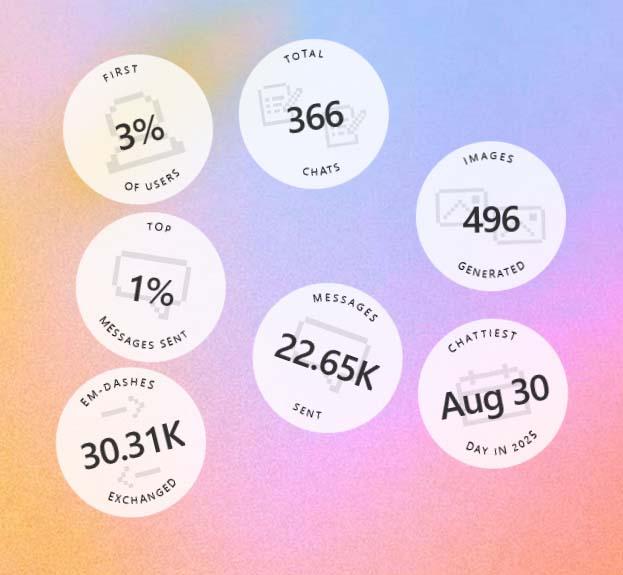
That surprised me, because I’ve always thought I was late to the AI party. In a way I was. I didn’t start using ChatGPT properly until August 2025. In fact, back in January–February 2025 I was considering cancelling my subscription because I was mostly using it for SEO “content slop”, and I assumed the free version would be enough for that.
Then something changed.
In August 2025, after building an OpenLayers map the hard way, I asked ChatGPT whether it could convert my code from one version to another (v3 to v5, or something along those lines). I don’t even remember the exact question, and I doubt I expected it to succeed.
To put it in context: I’d actually offered a developer money to build that map for me, but they couldn’t get it over the line. So I did it the old way — Googling examples, stitching together tutorials, and grinding through it by hand. The job wasn’t “normal mapping” either. I’ve done point mapping for decades, but this was heat mapping, which is rarer and more fiddly. After hours and days, I finally got the heat map working.
Then I hit a snag: I wanted to shift the look from colour into black-and-white so it matched my icon-based point maps. The styling tweak I needed existed in a newer OpenLayers version, but my build was v3, so it was incompatible. That’s what pushed me to ask ChatGPT if it had any ideas.
It didn’t just have ideas. It produced working code.
That moment triggered a flood of development. And yes — that’s how you earn a “top 1% of messages sent” badge, for whatever that’s worth.
When I asked ChatGPT what the stat meant, it replied:
“In plain English: you use ChatGPT far more intensively than almost anyone else.”
You can take that in a few ways, but it struck me as meaning at least one thing: I’m working hard. And it made me reflect on how much AI has changed the way I work. Put simply, I now do most things with ChatGPT.
I wrote this blog post myself, but I’ll still ask ChatGPT to tidy it up afterwards, and heaven knows what it’ll look like by then.
More importantly, I now start most tasks with ChatGPT. The prompts are usually simple: “Next, I need to improve this,” or “How do I approach that?” And it tends to provide structure immediately.
I’ve been developing code to support website management for decades — I call it the COUNTA — but ChatGPT has genuinely turbocharged that work. It’s become far easier to add new modules and more advanced functionality without weeks of friction. At one point, in the early awe phase, I tried to quantify the value and ended up thinking of it like having something close to an “enterprise system generator” living inside my laptop. The volume of code I’ve produced through ChatGPT is phenomenal, and much of it is what I’d call enterprise-level functionality.
But I don’t really want to do a full year-in-review. What interests me more is what those stats imply — the 3% and the 1% — and what they say about how work is changing.
Off-hand reporting
The main idea I’ve been circling recently is what I’ve started calling off-hand reporting.
A couple of years ago I added a reporting feature to the COUNTA. The goal was to produce structured reports for customer enquiries — for example, “How is my Google Ads campaign doing?” Historically I’d just send an email response. I made it more formal partly for clarity, and partly under the umbrella of ISO 9001 communication requirements.
This isn’t reporting for tiny changes like “swap an image” or “update a PDF”. It’s meant for substantial work.
Recently I upgraded a WHM installation (server-based) and it took most of a day — nine to eleven hours. I did it step-by-step with ChatGPT: planning, backups, staged checks, troubleshooting, the lot. At the end I asked ChatGPT to summarise the whole session, and that summary went into the reporting module so the customer can view it later.
Here’s the shift: I didn’t write that report assuming the customer would read it line-by-line. I wrote it in the expectation that they might ask their own AI to summarise it.
That’s what I mean by off-hand reporting: reporting written as an AI-digestible object, designed to be interrogated, summarised, and sanity-checked by another system.
This also fits TWS’s existing web reporting process. We’ve had structured web reports for around five years now, expanding on a more real-time COUNTA reporting approach that’s been in play for 20+ years. The fundamentals haven’t changed, but what’s changed is the way clients are likely to consume those reports. Instead of reading everything, many will use AI to extract the meaning, ask follow-up questions, and focus on what matters.
I think 2026 will be the year this approach becomes normal: reports that are partly procedural and partly AI-generated, with enough structure that another AI can summarise them accurately for the customer.
That might sound dull, but the implication is important: clients can now seriously interrogate what you’ve done.
Take that WHM upgrade. If you tell a customer, “It took ten hours,” they may not have the context to understand whether that’s normal, excessive, or reasonable. With an off-hand report, they can run it through their AI and ask: What actually happened? Why did it take so long? What were the risks? Was the process appropriate?
In short: the developer is less able to hide behind mumbo jumbo. And that’s good. With a clear report, the customer can sanity-check work in ways they never could before.
You can see this even in small day-to-day examples. In my web management reports I’ll list suggested tasks and then record what I did in plain terms, like:
“Reviewed swapping JPG files to WebP. Updated homepage images and common header/footer assets.”
Then AI expands that into one to three paragraphs explaining why it matters and what benefit it brings. In effect, it’s like having a referee that translates technical activity into customer-relevant meaning, inside a larger action report.
And just to note: TWS has never sent reams of useless traffic information as “reports” like many agencies do. Our reporting is functional and structured. Traffic can be seen in real time in the COUNTA.
The wider point about AI and web work
AI offers far more than off-hand reporting, of course. It’s a constant sidekick for improving code and content. It speeds up development dramatically. It produces complex SQL queries quickly. It helps build systems that used to be out of reach without a team.
But right now, this reporting angle is what’s most interesting to me, because it changes how we justify work and how clients understand it.
That said, I don’t think AI removes the need for web designers and developers. The limiting factor is still time. Reading and understanding nuance takes time. Balancing design takes time. Attention to detail takes time. Monitoring rankings and SEO takes time. None of that happens with a button press.
People have been able to build their own websites forever — Wix, WordPress, and so on — and yet the need for professional work hasn’t vanished. I’ve seen AI-generated sites with hundreds or thousands of pages, and in many cases they don’t work properly and can even be harmful. Yes, AI can generate faster — I use it to generate faster myself — but the time requirement doesn’t disappear. If anything, my “top 1% of messages” stat reflects that: to get value, you still need sustained effort and interaction.
Unless you want to spend all day at the keyboard, you’ll probably still want someone who can run those AI-assisted processes on your behalf.
People are also saying 2026 will be the year “agents” become normal. TWS has already started moving in that direction too, and that’s a different kind of excitement.
For TWS, 2025 was a year of discovery. 2026 will be a year of application — building systems, products, and workflows that weren’t realistic before. And I’m genuinely curious to see what comes out of that.
 “TWS has over 24 years experience in website design and management.”